Global
 Region

 Contact










 Principles & vision


 Procurement

Global
Region
Principles & vision
Procurement
As economic conditions and society change, it is essential for a company’s mid- to long-term growth that each and every one of its diverse employees fully demonstrates his or her abilities. To this end, we are working to change our work style to one that is productive and dynamic, and to create a work environment in which employees can work with peace of mind by managing the balance between work and private life.
| Materiality | Create a rewarding workplace and human resource development |
|---|---|
| Desired outcomes |
Raise employees’ awareness of human rights and create a workplace where human rights are respected |
| Initiatives[Targets] | Human rights and work practices
|
| FY2024 Results | Non-consolidated/Domestic group: Continued implementation of human rights due diligence Overseas: Confirmation of legal and social requirements at major sites |
*1 Target was revised in April 2024
We introduced a telework system to create an environment in which productivity and results can be achieved regardless of time or place. Through the use of ICT, we have introduced a tool for managers and employees to confirm and communicate their daily work plans and performance remotely and have developed a system that enables fair evaluation.
In addition, in order to encourage the participation of a diverse range of human resources, we reexamined the manner in which employees are transferred and introduced an area-limit system that allows employees to choose their work location according to their life events, regardless of the reason, and that does not involve changes in treatment.
Moreover, we will improve work-life management by encouraging men to take child-care leave, thereby improving productivity and job satisfaction. The ratio of men taking child-care leave was 60% in FY2024.

In fiscal 2017, we introduced a system that allows employees to take accumulated leave on an hourly basis, work at home, and take a leave due to their spouses’ overseas transfer. We are increasing the number of work options to support a balance between childcare and nursing care and work. With regard to childcare in particular, since fiscal 2018, we have been receiving a “Platinum Kurumin Certification” from the Minister of Health, Labor and Welfare, in recognition of the introduction and increased use of systems that support balancing work and family, as well as our high standards of measures.
In April 2021, we introduced a new telework system, replacing the existing work-from-home system, which has limits on the number of days and reasons, with the aim of establishing an environment in which employees can work flexibly, regardless of location or time, and achieve results by increasing productivity. By using the telework system, many employees who need to balance work with childcare, nursing care, and medical treatment can work continuously.
Below is a part of Yaskawa’s childcare and nursing support system.
| Shorter working hours |
Employees with childcare and nursing care responsibilities can shorten working hours to six hours a day. *In the case of childcare, applicable until the child graduates from elementary school |
|---|---|
| Spouse childbirth leave (paid leave) |
Five days of leave can be taken within eight weeks before and after the due date. *Leave can be split. |
| Childbirth leave for fathers |
Leave given to fathers for up to four weeks within eight weeks of the childbirth. *The leave can be split. |
| Accumulated leave (paid leave) |
Accumulated leave of three days a year are granted from the second year of working at Yaskawa. Accumulated leave can be held for up to 30 days and can be used for childcare, PTA activities, nursing care, etc. and can be taken on a daily, half-day, or hourly basis. |
| Telework |
In addition to work-from-home, the system enables working at in-house satellite offices or mobile working, and there is no upper limit on the number of days or hours the employees can use if approved by their supervisor. |
Yaskawa has appointed a Balancing Support Coordinator since 2018 to enable employees who are sick but have the motivation and ability to work to continue to work vigorously while receiving appropriate medical treatment, free from anxiety.
Accumulated leave can be used not only for childcare or nursing care but also for self-treatment, volunteer activities and self-development. In recent years, natural disasters have increased, and many employees have taken advantage of the accumulated leave to participate in volunteer disaster recovery activities.
The flextime system allows employees to allocate work and private time according to their daily convenience, and to decide when to come in and leave work within the total working hours for a period of one month. In addition to utilizing childcare, nursing care and personal development, the system aims to enhance the fulfillment by working in a flexible manner.
As part of its efforts to create a company that is rewarding to work, Yaskawa encourages employees to take five consecutive days off a year, and many employees take advantage of this system. Through these efforts, we aim not only to take time off to improve our work-life management, but also to create a workplace environment that is free from unreasonableness and waste.
Yaskawa’s labor union began as the Yaskawa Electric Manufacturing employees’ union on December 25, 1945 and later changed its name to Yaskawa Workers Union, which is currently under the Japanese Electrical Electronic & Information Union (“JEIU”).
The number of union members, including associated companies, stands at 3,452 as of February 28, 2025 and there is no labor union organized for part-timers or contract employees. Yaskawa also organizes Yaskawa Group Union, comprising Yaskawa Workers Union, YAD Workers Union, Food & Agri Mechatro Solutions Workers Union, YEM Workers Union, and YMS Workers Union under JEIU. Yaskawa and its domestic affiliates, which organize labor unions, have concluded collective agreements with the labor unions of each company and, by respecting each other‘s standpoint, have established orderly labor-management relations and proper working conditions.
In order to conduct smooth operations based on its administration rights with understanding and trust from the union, the company holds a joint management council for the company president, managements and workers union officials once every half-year to discuss business and labor issues, as well as a regular monthly meeting to share and discuss business situations and other topics. A labor-management committee is also held to improve working conditions and treatment of union members.
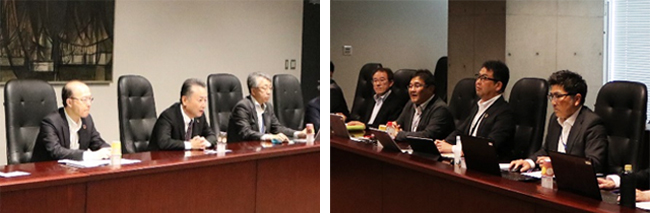
Dialogue between labor and management


Copyright © 2003‐2026 YASKAWA ELECTRIC CORPORATION.