Global
 Region

 Contact






 Principles & vision


 Procurement

Global
Region
Principles & vision
Procurement
The Yaskawa Group Code of Conduct sets forth the following to pursue optimal procurement, understand suppliers, and ensure sound relationships and proper payment procedures. Suppliers are also required to comply with the law.
We will conduct fair and equitable transactions in accordance with the basic agreement on transactions in order to fulfill our social responsibilities such as compliance and consideration for the environment together with our business partners. We make decisions based on the results of the evaluation in “quality” “price” “delivery” “management information” “consideration for the environment”.
In search of new suppliers, we open our doors to the world and provide fair and equitable trading opportunities based on free competition.
We will strive to build partnerships with business partners through CSR (corporate social responsibility) and fair trade in compliance with laws and regulations.
We have established the “Green Procurement Guidelines” with the aim of procuring materials with low environmental impact, and are working with our suppliers to protect the global environment. We are also implementing thorough management of hazardous substances based on our environmental management system.
When the Yaskawa Group procures products, materials, and raw materials, it works with suppliers to ensure that they comply with guidelines that incorporate CSR elements such as the environment, the labor environment, and human rights, as well as such existing factors as quality, performance, price, and delivery time, in order to contribute to solving social issues throughout the supply chain.
| Materiality | Sustainable and productive manufacturing |
|---|---|
| Desired outcomes |
Implement supply chain management based on compliance with sustainable procurement guidelines |
| Initiatives [Targets] |
|
| FY2024 results | Completed developing sustainable procurement policies and established guidelines for 2 overseas group companies |
*1 Target was revised in April 2022.
Yaskawa holds a Procurement Policy Briefing every six months for managers of major suppliers with whom we do business on a global basis, and shares and harmonizes our management policy and business strategy. At the briefing, opinions are exchanged so that we can reflect the opinions of suppliers in our purchasing policies and enhance their effectiveness.
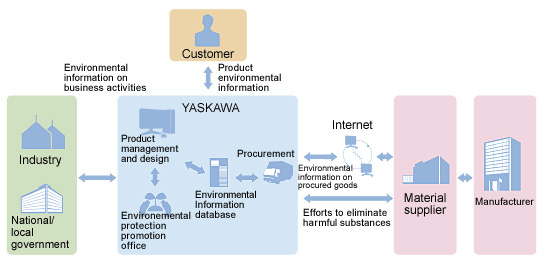
In Yaskawa’s pursuit to create products in harmony with the environment, Yaskawa communicates with materials suppliers via the Internet through the exchange of environmental information on procured products and information on supplier’s environmental preservation initiatives.
We are actively accepting proposals for the procurement of “materials with low environmental impact” from “suppliers actively involved in environmental conservation activities”.
Yaskawa Group established the “Sustainable Procurement Guidelines” in February 2021. These guidelines set forth a code of conduct to be observed by suppliers. The guidelines were posted on our website to disseminate the guidelines to all suppliers.
As part of the Yaskawa Group’s initiatives, our domestic group companies conduct an SAQ*2 survey every two years for major business partners*3. We received responses from 216 companies in fiscal 2022 and from 180 companies in fiscal 2024.
For our overseas group companies, we obtained SAQ responses from 51 business partners in China in fiscal 2023, and from 34 business partners in the United States and 18 in India in fiscal 2024.
As a result of SAQ survey, it has been confirmed that the suppliers comply with the guidelines both in Japan and overseas.
*2 Major business partners: Business partners that account for the top 80% of the previous year’s purchase value.
*3 SAQ:Self Assessment Questionnaire
Some minerals (Tin, tantalum, tungsten, gold) produced in the Democratic Republic of the Congo or neighboring countries are called conflict minerals because there are concerns that such minerals are a source of funds for armed groups that commit human rights violations, acts of violence and other illegal activities. Yaskawa formulated the “Conflict Minerals Clause Guidelines” in 2013 to clarify response policies. Through these efforts, we are working to eliminate the flow of funds to armed insurgents, and is earnestly tackling human rights issues in the Congo region.
In order to realize Yaskawa’s management principle of “contributing to the welfare of humankind” we will work with our business partners to ensure that we comply with the provisions on conflict minerals.
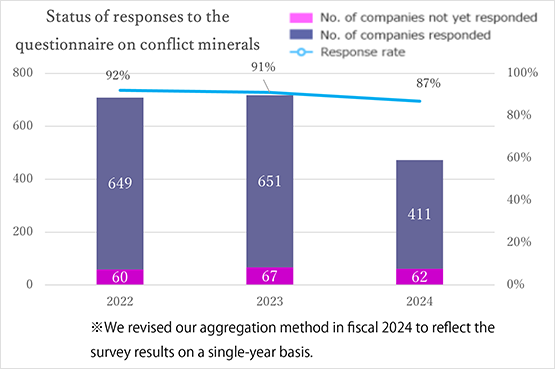
Studies to date have not confirmed the use of raw materials to finance the rebels. In the future, if the use of raw materials is discovered as a source of funds for the armed groups, we will promptly replace them.


Copyright © 2003‐2026 YASKAWA ELECTRIC CORPORATION.