Global
 Region

 Contact




 Principles & vision


 Procurement

Global
Region
Principles & vision
Procurement
Yaskawa Electric recognizes the importance of corporate ethics based on compliance with laws and regulations, and considers it an important issue to enhance corporate value by speeding up management decision-making in response to changing social and economic environments and improving management soundness.
To achieve this, we will build good relationships with our stakeholders, including shareholders, customers, business partners, local communities, and employees. We will also further strengthen our current institutions, including the General Meeting of Shareholders, Board of Directors, Audit and Supervisory Committee, and Accounting Auditor, while enhancing corporate governance.
For our shareholders and investors, we will strive to disclose information promptly and accurately, and at the same time, enhance management transparency by disclosing a wide range of information.
Yaskawa Electric implements all of the principles of Corporate Governance Code.
Yaskawa Electric has adopted a corporate structure with an Audit and Supervisory Committee in order to further strengthen the oversight function of the Board of Directors over management and corporate governance, as well as to enhance the soundness and efficiency of management. The Company believes that the supervisory function of the Board of Directors will be further enhanced by utilizing the legal functions of Audit and Supervisory Committee Members, such as the ability of Audit and Supervisory Committee Members as directors to exercise voting rights at the Board of Directors on important matters of the Company, such as the appointment and dismissal of Representative Directors, and the ability to examine the results of the execution of business by Executive Directors and to express opinions at the General Meeting of Shareholders on the appointment, dismissal and remuneration of Executive Directors. In addition, the Company has introduced an executive officer system to separate management decision-making and business execution functions, enhance each function, and speed up business execution.
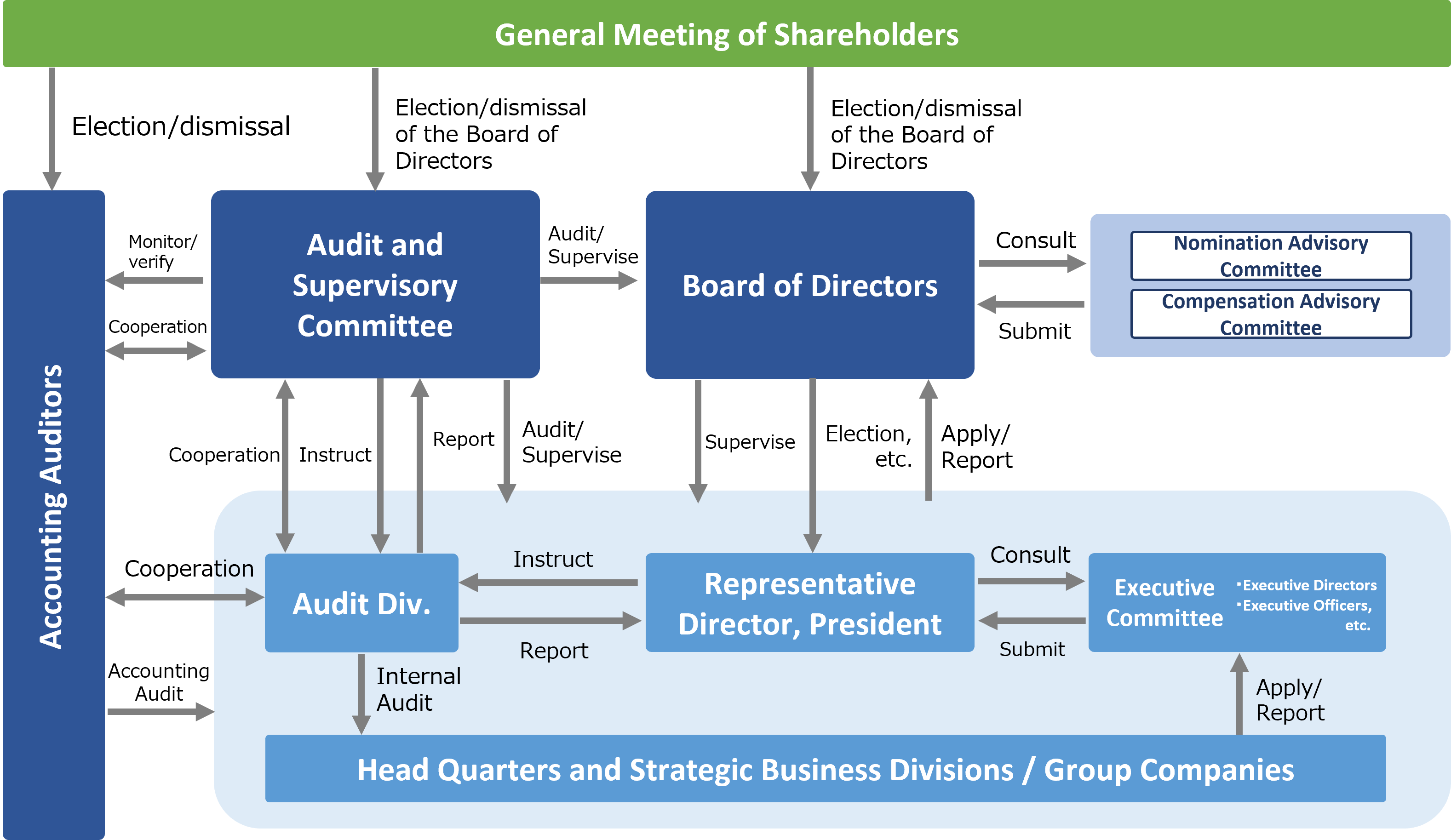
Yaskawa Electric’s Board of Directors consists of 9 members, including 4 internal and 5 outside directors.
In addition to the regular meetings of the Board of Directors, the Board of Directors convenes extraordinary meetings as necessary to decide on important matters related to management and matters stipulated by laws and regulations, and to supervise the status of business execution on an ongoing basis.
Yaskawa has appointed Hisanori Makaya, Harumi Mukai, Keiji Nishio, Yaeko Hodaka and Chikako Irie as Outside Directors to provide advice and suggestions from an independent perspective on overall management of Yaskawa based on their diverse perspectives, experiences and advanced expertise. In deliberations by the Board of Directors, Outside Directors fully understand the current status of Yaskawa based on information submitted or reported by the Internal Audit and Control Division, Corporate administration operations and other functions, and the Accounting Auditor provide advice and proposals based on their respective knowledge, thereby fulfilling appropriate supervisory functions.
The Audit and Supervisory Committee consists of 4 directors (of which three are outside directors) who are Audit and Supervisory Committee Members, and audits the status of execution of duties by Directors and others. In conducting audits, the Audit and Supervisory Committee fully understands the current status of Yaskawa Electric based on information reported by the Internal Control Division, the Internal Audit Division, and the head office business divisions, while full-time Audit and Supervisory Committee Members conduct audits based on actual inspections. In addition, the Audit and Supervisory Committee carries out duties in cooperation with the Accounting Auditor, and monitors and verifies the duties of the Accounting Auditor.
Yaskawa Electric has appointed EY ShinNihon LLC as an accounting auditor, and has provided accurate management information under an auditing contract and created an environment in which audits are conducted from an independent standpoint. We consult with and receive advice from our accounting auditors when they need to make a decision.
The Executive Committee is composed of executive directors and executive officers and discusses important decisions related to business execution, including reports on the progress of management plans and deliberations on policies and measures for all businesses. As a general rule, meetings are held once a month, and extraordinary meetings are held as necessary to establish a flexible and prompt business execution system.
The Nomination Advisory Committee, of which the majority are independent outside directors, has been established under the Board of Directors to ensure the transparency and fairness of the nomination of director candidates, the selection process of representative directors and officers, etc., and to ensure a forum for outside directors to obtain and discuss sufficient information to form opinions on the nomination of director candidates, etc. When submitting proposals regarding the nomination, etc. of director candidates, etc. to the Board of Directors, the details thereof shall be fully reflected upon the report of the Committee.
The Compensation Advisory Committee consisting of a majority of independent outside directors is established under the Board of Directors to ensure the appropriateness and transparency of the remuneration of directors (excluding directors who are Audit and Supervisory Committee Members) and executive officers through fair deliberations, and to ensure a forum for outside directors to obtain sufficient information and discuss the remuneration in order to form opinions.
The Committee deliberates on the compensation for directors calculated in accordance with the directors’ compensation rules and other necessary matters concerning directors’ compensation from the viewpoint of appropriateness.
| Directors | Structure | |||||
|---|---|---|---|---|---|---|
| Board of Directors | Audit and Supervisory Committee | Nomination Advisory Committee | Compensation Advisory Committee | |||
| Hiroshi Ogasawara | (70) | ◎ | ○ | ○ | ||
| Ayumi Hayashida | (61) | ○ | ||||
| Yumie Kubota | (58) | ○ | ||||
| Hisanori Makaya | (68) |
Outside
Independent
|
○ | ○ | ◎ | Harumi Mukai | (60) |
Outside
Independent
|
○ | ○ | ○ |
| Takeshi Ikuyama | (62) | ○ | ◎ | |||
| Keiji Nishio | (67) |
Outside
Independent
|
○ | ○ | ◎ | ○ |
| Yaeko Hodaka | (60) |
Outside
Independent
|
○ | ○ | ○ | ○ |
| Chikako Irie | (54) |
Outside
Independent
|
○ | ○ | ○ | ○ |
◎Chairperson ○Member
(Note)The ages are as of May 27, 2026, at the 110th Annual General Shareholders Meeting.
| Directors | Areas of expertise that the Company expects each Director to demonstrate | ●Male ○Female |
||||||||
|---|---|---|---|---|---|---|---|---|---|---|
| Corporate management/Business strategy | ESG/Sustainability | Finance Accounting | Legal affairs | Sales Marketing | Manufacturing R&D/DX | Global | ||||
| Hiroshi Ogasawara | (70) | ● | ● | ● | ● | ● | ● | |||
| Ayumi Hayashida | (61) | ● | ● | ● | ● | ● | ● | |||
| Yumie Kubota | (58) | ● | ● | ● | ● | ● | ○ | |||
| Hisanori Makaya | (68) |
Outside
Independent
|
● | ● | ● | ● | ● | ● | ||
| Harumi Mukai | (60) |
Outside
Independent
|
● | ● | ● | ● | ○ | |||
| Takeshi Ikuyama | (62) |
Member of
the Audit and Supervisory Committee |
● | ● | ● | ● | ● | ● | ||
| Keiji Nishio | (67) |
Member of
the Audit and Supervisory Committee Outside Independent |
● | ● | ● | ● | ● | ● | ||
| Yaeko Hodaka | (60) |
Member of
the Audit and Supervisory Committee Outside Independent |
● | ● | ● | ● | ○ | |||
| Chikako Irie | (54) |
Member of
the Audit and Supervisory Committee Outside Independent |
● | ● | ● | ● | ○ | |||
(Note)The table above does not cover all the expertise each candidate possesses.
Age is as of the 110th general meeting of shareholders held on May 27, 2026.
Individuals who do NOT correspond to any of the following items can be appointed as independent outside directors, with regards to the independence standards set by the Financial Instruments Exchange.
In addition, the basic term of office as an outside director of our company is 4 years, and it may be extended for an additional year if there are unavoidable business reasons.
|
Name |
Attendance Status (FY2025) |
|
|---|---|---|
|
Board of Directors |
Audit and Supervisory Committee |
|
|
Hisanori Makaya |
10 times/10 times |
– |
|
Kaori Matsuhashi |
13 times/13 times |
13 times/14 times |
|
Keiji Nishio |
13 times/13 times |
14 times/14 times |
|
Yaeko Hodaka |
13 times/13 times |
14 times/14 times |
(Note)Mr. Hisanori Makaya was newly elected at the 109th Ordinary General Meeting of Shareholders held on May 28, 2025. Therefore, the number of attendance and meetings of the Board of Directors differ from those of other Outside Directors. |
||
(1) Methods of analysis and evaluation
In FY2025, Yaskawa conducted a questionnaire survey of all Directors, including Audit and Supervisory Committee Members, hereinafter referred to as the “Survey,” and interviews with Outside Directors regarding the evaluation of effectiveness, hereinafter referred to as the “Interviews.” The Survey and the Interviews consisted of evaluation items related to the size, composition, and operation of the Board of Directors, the functioning of the Board of Directors, management of business plans, support systems for Outside Directors, and overall management, including management issues and strengthening of the management structure.
(2) Summary of evaluation results
As a result of the Survey, positive responses accounted for more than 90% of all responses, indicating that the effectiveness of the Board of Directors is generally ensured.
On the other hand, the items identified through the Survey and the Interviews as requiring improvement include enhancement of discussions on the allocation of management resources and enhancement of the deliberations of the Nomination Advisory Committee.
(3) Future initiatives
As described above, Yaskawa has evaluated that the effectiveness of the Board of Directors is generally ensured at present, and has recognized various issues. Based on these findings, Yaskawa will implement measures to ensure that discussions to further improve the effectiveness of the Board of Directors are held at the Board of Directors’ meetings and other committees.
In addition, Yaskawa plans to utilize analysis, evaluation, and recommendations for improvement by a third-party organization approximately once every three years, and the most recent evaluation was conducted in FY2024.
For FY2026, Yaskawa also plans to conduct an evaluation of effectiveness in a format combining questionnaire surveys and interviews with each Director.
As a Business-to-Business manufacturing company, Yaskawa’s management requires in-depth knowledge of market characteristics and technological trends, it has selected a system with an Audit and Supervisory Committee as an institutional design for its organization.
At the same time, we have developed a governance system to enhance the effectiveness of the Board of Directors by actively incorporating external knowledge, and to strengthen both defensive and offensive governance, in order to continuously improve corporate value. Yaskawa will continue to pursue its best, enhance management transparency, and further enhance corporate governance.
|
FY |
FY2012-FY2014 |
FY2015-FY2017 |
FY2018-FY2025 |
|
|---|---|---|---|---|
|
Main measures |
FY2012 ・Adoption of executive officer system ・Number of Directors was reduced to 12 from 20
FY2014 ・Compensation Advisory Committee established |
FY2015 ・Transition to a company with Audit and Supervisory Committee ・Nomination Advisory Committee established
FY2016 ・Evaluation of the Effectiveness of the Board of Directors commenced |
FY2018 ・More than 1/3 of the Board of Directors are independent Outside Directors
FY2019 ・Skills Matrix of the Board of Directors Disclosed
FY2020 ・Determination of basic policies for executive compensation ・Corporate Governance Policy of Yaskawa established
FY2021 ・Sustainability Policy established
FY2022 ・Opinion Exchange Meeting of the Board of Directors commenced FY2025 ・Interview of the Effectiveness of the Board of Directors commenced |
|
|
Aim and purpose |
・Faster and more efficient management decision-making and execution ・Ensuring the appropriateness and transparency of executive compensation |
・Strengthening of offensive and defensive governance ・Ensuring transparency and fairness in nomination of director candidates ・Improving the functions of the Board of Directors to increase corporate value |
・Improving the independence and objectivity of the Board of Directors ・Enhancement of information disclosure ・Contributing to the realization of a sustainable society in addition to improving corporate value ・Enhancement of understanding our business for Outside Directors in addition to improving effectiveness of the Board of Directors meeting |
|
|
Institution establishment |
Company with Board of Corporate Auditors |
Company with Audit and Supervisory Committee |
||
|
Composition of the Board of Directors |
Internal |
6 |
8* |
4* |
|
Independent outside |
1 |
3* |
4* |
|
|
Composition of Audit and Supervisory Committee |
Internal |
2 |
2 |
1 |
|
Independent outside |
2 |
3 |
3 |
|
*Including directors who are members of the Audit and Supervisory Committee.
(Note) The No. of members of the Board of Directors and the Audit and Supervisory Committee are of the latest figure of the corresponding fiscal years on the table.
The policy for determining compensation, etc. for each individual Director has been resolved by the Board of Directors.
With the aim of continuously increasing corporate value and strengthening competitiveness, officer compensation at Yaskawa is designed to maintain a level of compensation that secures talented human resources and provides incentives for short-term, medium- to long-term performance improvement.
In addition, single-year performance-linked compensation is paid according to the profit results of the previous fiscal year in order to encourage the entire organization to work together toward continuous profit improvement. Medium- to long-term compensation is designed to encourage awareness of enhancing corporate value over the medium to long term and to share benefits with stakeholders.
At the 99th Annual General Meeting of Shareholders held on June 18, 2015, a resolution was passed to set a fixed limit of 430 million yen or less for the basic remuneration of Directors. Details are as follows. The number of Directors subject to this basic remuneration is 12 or less, as stipulated in the Articles of Incorporation.
・Directors (excluding outside directors)
As directors assume the responsibility of improving corporate value, a certain amount will be paid according to the performance evaluation and position of each Director.
・Outside Directors
Outside directors are responsible for supervising the execution of duties, so a fixed amount is paid in advance.
At the 99th Annual General Meeting of Shareholders held on June 18, 2015, the Company resolved as follows. The number of Directors who are eligible for this performance-linked compensation is limited to 12 or less in accordance with Yaskawa’s Articles of Incorporation.
・Directors (excluding outside directors)
The maximum amount of performance-linked compensation shall be 1.0% or less of the consolidated net income of the fiscal year prior to the general meeting of shareholders elected or reappointed, in order to further clarify the link with consolidated performance. The amount of remuneration for each Director is calculated by taking into account the relative results to Yaskawa’s business performance from the standard deviation based on operating profit rate, operating profit growth rate and ROA of other companies in the same industry.
・Outside Directors
Performance-linked compensation is not provided.
Based on the resolutions adopted at the 101st Annual General Meeting of Shareholders held on June 15, 2017, the 103rd Annual General Meeting of Shareholders held on May 28, 2019, and the 105th Annual General Meeting of Shareholders held on May 26, 2021, the Company has introduced a stock compensation plan for directors, the “Board Benefit Trust (BBT).” This plan is a stock-based compensation system that is linked to the degree of achievement of performance indicators set forth in the Company’s medium-term management plan. Through this system, directors share not only the benefits of an increase in the Company’s stock price but also the risks associated with a decrease in the stock price together with shareholders. The aim is to further enhance directors’ motivation to improve medium- to long-term business performance and increase corporate value.
The compensation under this plan was approved at the 105th Annual General Meeting of Shareholders held on May 26, 2021, and its outline is as follows. As of the conclusion of the said shareholders’ meeting, the Board of Directors consisted of six directors (excluding outside directors) and one outside director.
・Directors (excluding Outside Directors)
The evaluation indices used to calculate stock-based compensation in mid-term business plan “Dash 35” from FY2026 to FY2029 are as follows.
The stock compensation is calculated by the performance factor according to the target value of each evaluation index.
・Outside Directors
A predetermined number of points will be awarded only when the company‘s target operating profit for each fiscal year set forth in the medium-term management plan is achieved.
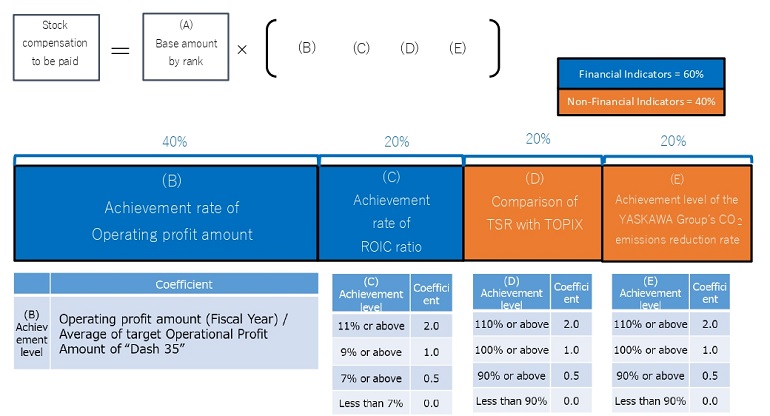
Considering the size and responsibilities of the areas in which Directors are responsible and their contribution to Group management, the Company sets the base amount according to their positions.
Evaluations are based on operating profit amount for each fiscal year of the mid-term business plan “Dash 35” from FY2026 to FY2029.
Evaluations are based on the actual ROIC for each fiscal year of the mid-term business plan “Dash 35” from FY2026 to FY2029.
Evaluations are conducted according to the degree of achievement of TSR with the aim of motivating directors to increase corporate value from the shareholders’ point of view.
In order to realize sustainable corporate activities and respond to social issues, Yaskawa evaluates Achievement level of the YASKAWA Group’s CO2 emissions reduction rate.
・Directors (excluding outside directors)
Directors’ compensation consists of basic compensation, which is fixed compensation, as well as performance-linked compensation and stock compensation, which vary according to performance. In the event that performance targets are achieved, the composition ratio of basic compensation, performance-linked compensation and stock compensation for the President and Representative Director is assumed to be approximately 30%:55%:15%
・Outside Directors
From the perspective of independence, performance-linked compensation will not be paid, and base compensation as well as non-performance-linked stock compensation only when performance targets are achieved will be paid. The proportion of outside directors’ remuneration shall be as follows.
The maximum amount of basic remuneration for Directors who are the members of the Audit and Supervisory Committee was fixed at a maximum of 150 million yen per year and resolved at the 104 th Ordinary General Meeting of Shareholders held on May 27, 2020. The number of Audit and Supervisory Committee Members subject to this basic remuneration shall be six or less pursuant to the provisions of the Articles of Incorporation of Yaskawa.
A predetermined number of points will be awarded only if the target operating profit for each fiscal year, as set forth in the medium-term management plan, is achieved.
| Director category | Number of directors | Total amount of compensation(millions of yen) | |||
|---|---|---|---|---|---|
| Monetary compensation | Non-monetary compensation | ||||
| Basic compensation | Performance-linked compensation | Stock-based compensation | |||
| Directors (excluding Directors who are Audit and Supervisory Committee Members and Outside Directors) |
4 | 448 | 188 | 213 | 46 |
| Directors who are Audit and Supervisory Committee Members (excluding outside directors) |
1 | 31 | 31 | – | – |
| Outside Directors | 5 | 65 | 65 | – | – |
(Note) The above includes 1 Director (excluding Directors who are Audit and Supervisory Committee Members and Outside Directors) and 1 Outside Director retired at the conclusion of the 109th Annual General Shareholders Meeting held on May 28, 2025.


Copyright © 2003‐2026 YASKAWA ELECTRIC CORPORATION.