Global
 Region

 Contact




 Principles & vision


 Procurement

Global
Region
Principles & vision
Procurement
We established the Group Environmental Policy in fiscal 2015 in order to accelerate global environmental initiatives, including those of overseas affiliates.
Based on the Management Principles of the Yaskawa Group, we recognize that the conservation of the global environment is one of the most important issues for all humankind. In every stage of our business operation, we contribute to the realization of a sustainable society through our proactive environmentally conscious actions.
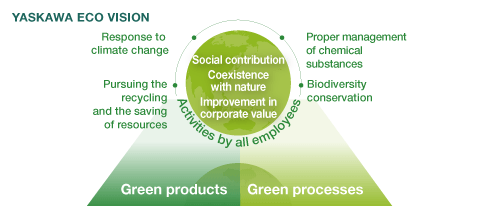
Yaskawa makes contributions to the environment by reducing the burdens that result from its business activities (green process) at a greater rate, and by reducing the burden on the ecosystem with its products (green products) leveraging its technology to enhance the environmental performance.
As climate change poses a number of problems on a global scale, we are striving to enhance corporate value by pursuing sustainability through multifaceted environmental activities, with a focus on reducing CO2 emissions through products that utilize one of our company’s core competences of power conversion.
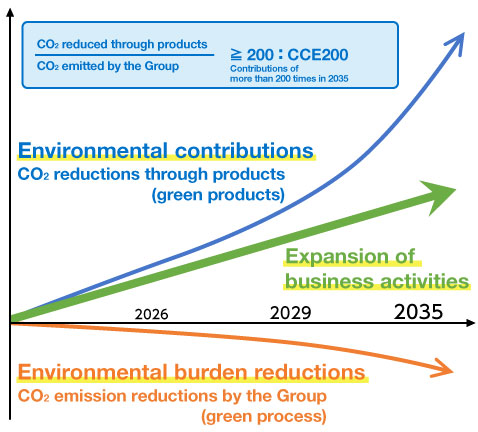
We have launched our long-term management plan, “Vision 2035” (FY2026 to FY2035), as well as our medium-term management plan, “Dash 35” (FY2026 to FY2029), which covers the first four years of Vision 2035. In line with these plans, we have established new targets under our medium- and long-term environmental plan and will further strengthen our efforts to address environmental challenges.
| Category | Metric | Scope | Medium-term Target (FY2029) |
Long-term Target (FY2035) |
|
|---|---|---|---|---|---|
| Green processes |
CO2 | CO2 Emissions Reduction Rate*1 (vs. FY2018) |
Yaskawa Group | 46% | 72% |
| CO2-free electricity ratio | Yaskawa Group | 55% | 75% | ||
| Waste | Reduction rate in waste generation per unit of sales (vs. FY2025) | Yaskawa Group | 4% | 10% | |
| Final disposal rate | Yaskawa Electric | 1% or less | 1% or less | ||
| Effective utilization rate of plastic waste | Yaskawa Electric | 95% or greater | 95% or greater | ||
| Water | Reduction rate in water withdrawal per unit of sales (vs. FY2025) | Yaskawa Group | 10% | 30% | |
| Green products |
Contribution to CO2 emissions reduction through products (cumulative from FY2026 onward) | Yaskawa Group | 120 million tons | 290 million tons | |
| Compliance with environmental regulations for products | Yaskawa Group | 100% | 100% | ||
| Management | Compliance with environmental laws and regulations at business sites | Yaskawa Group | 100% | 100% | |
| Environmental impact data collection rate*2 | Yaskawa Group | 95% | 95% | ||
| Others | CCE200 | Yaskawa Group | 130× | 200× | |
*1 Scope1+2
*2 Energy, water, and industrial waste
| Mid-term plan targets for FY2025 |
Progress in FY2025 |
Self- evaluation |
||
|---|---|---|---|---|
| Green processes |
The Group’s CO2 emission reduction rate |
30% (Compared to FY2018) | 35% | ○ |
| CO2-free electric power rate | 75% (Yaskawa Electric) | 85% | ○ | |
|
Reduce volume of waste discharged by the Group |
FY2018 results (3,986 tons) or less |
3,300 tons | ○ | |
| Proper water management |
Reduce volume of water consumed by Yaskawa Electric Reduce by 1% compared to FY2022 results (169 thousand m3) |
167 thousand m3 | ○ | |
| Green products |
Contribution to reducing CO2 emissions through products |
120.00 million tons (Cumulative since FY2016) |
166.63 million tons |
○ |
|
Compliance with the RoHS Directive |
100% | 101% | ○ | |
| Management |
Increase in the number of companies covered under EMS in the Yaskawa Group |
Environmental impact load ratio: 99% or greater |
96% | △ |
Self-evaluated achievement ratios to targets: ◎130% or more, ○100% or more, △50% or more, × under 50%
The Yaskawa Group promotes environmental management through two complementary approaches: reducing the environmental impact of its business activities (green processes) and contributing to the reduction of environmental impact for customers around the world through its products (green products). In particular, recognizing climate change as an urgent global issue, we have advanced our environmental management initiatives under the goal of achieving “CCE100 (Contribution to Cool Earth 100)”, which aims to make the CO2 emissions reduction enabled by our products more than 100 times the CO2 emissions generated by the Yaskawa Group’s business activities by FY2025. In FY2025, we achieved a CCE100 performance of 101 times, thereby meeting our target.
Building on this achievement, our new medium- and long-term environmental plan, which begins in FY2026, introduces “CCE200” as a new target to further accelerate our contribution to addressing climate change. Through the further expansion of green products and the promotion of decarbonization in our business activities, we aim to increase the CO2 emissions reduction enabled by our products to more than 200 times the CO2 emissions generated by the Yaskawa Group’s business activities by FY2035. Through these efforts, we will contribute to the realization of a sustainable society and the enhancement of corporate value.
Yaskawa and its affiliated companies have continued to promote the environmental programs in accordance with group-wide policies and implementation plans that have been deliberated and decided by the Company-wide Environmental Promotion Committee.
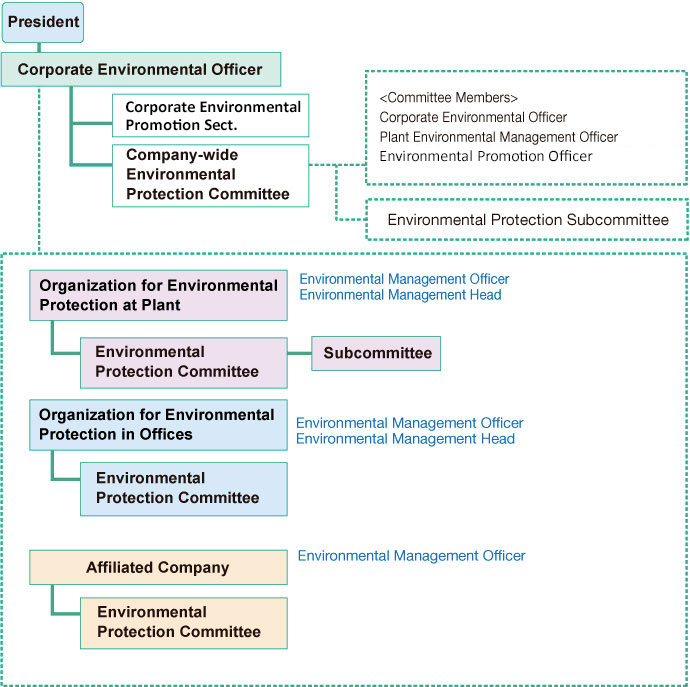
The Group Environmental Policy is incorporated into the environmental targets of each affiliated company, and environmental activities are carried out in accordance with the business contents.
Yaskawa began acquiring ISO 14001 (Environmental Management System) certification for its manufacturing facilities in 1998, and we acquired integrated certification for our manufacturing facilities in Japan in 2014*1.
We are also expanding the scope of certification to include Group companies, and we will continue to promote environmental management globally based on ISO 14001.
In FY2025, Yaskawa Electric obtained ISO 14001 certification at all five of its production sites. Across the entire group, 16 out of 27 sites have been certified.
| Number of production sites |
Number certified | Certification rate | |
|---|---|---|---|
| Yaskawa Electric | 5 | 5 | 100% |
| Yaskawa Group | 27 | 16 | 59% |
*1 Scope of ISO 14001 at Yaskawa: All stages of manufacturing activities, products, and services in the departments of the Iruma Plant, Yahata-nishi Plant, Nakama Plant, Yukuhashi Plant, and Yahata-higashi Plant and in affiliated companies on the premises of those plants.
List of ISO 14001 Certification for Group CompaniesTo improve the effectiveness of our environmental management system and reduce environmental risks, we conduct environmental audits at branch offices, sales offices, plants, and affiliated companies. These audits assess compliance with environmental laws, regulations, and internal rules, as well as the progress of environmental plans and initiatives related to CO2 reduction, waste management, chemical substance management, and green procurement, thereby supporting continuous improvement.
In FY2025, environmental audits were conducted at seven Yaskawa Electric sites and two Group companies.
To ensure strict compliance with environmental laws and regulations, Yaskawa has established internal rules regarding the identification of applicable laws and regulations at each business site, as well as the required actions and implementation procedures.
Compliance is verified by the ISO Management Office and the promotion offices at each business site. In FY2025, there were no violations of laws or regulations and no penalties imposed on Yaskawa. There was also no pollution that could adversely affect the environment.
With the focus set on the responsibility of the waste generator, we perform, by use of our common audit check sheets, on-site checks of waste collection/transport companies and disposal companies under contract with our production plants.
Until FY2025, none of our contractors have violated laws and regulations.
We will continue to perform these checks in the future.
The Yaskawa Group discloses information on its environmental activities and actively communicates with stakeholders to deepen mutual understanding. We are also disseminating information on our environmental initiatives and views widely through our integrated report and website, and will continue to strengthen our efforts.
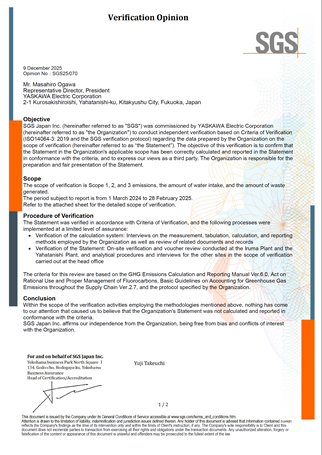
We disclose information on the Yaskawa Group’s initiatives and environmental impact data to a variety of stakeholders, including government agencies and industry groups, as well as through CDP’s survey on climate change and water security and “SDGs management“ survey conducted by Nikkei Research.
To improve the reliability of the calculated greenhouse gas emissions (Scope 1, 2, and 3), we receive third-party verification by SGS Japan Inc.
The Yaskawa Group emits CO2 and waste materials as a result of using energy, such as electricity, gas, etc., and resources, such as components/materials, water, etc., for manufacturing, sales, engineering, etc., of electrical products and systems, and other related businesses.
The below figure illustrates the status of environmental loads of our production and sales activities.
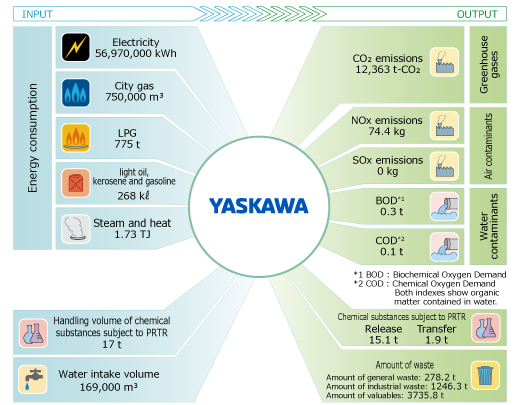
Environmental Impact Data Summary (FY2025)
【Range of applicability of data】Yaskawa Electric and group companies
and partners within Yaskawa Electric business sites
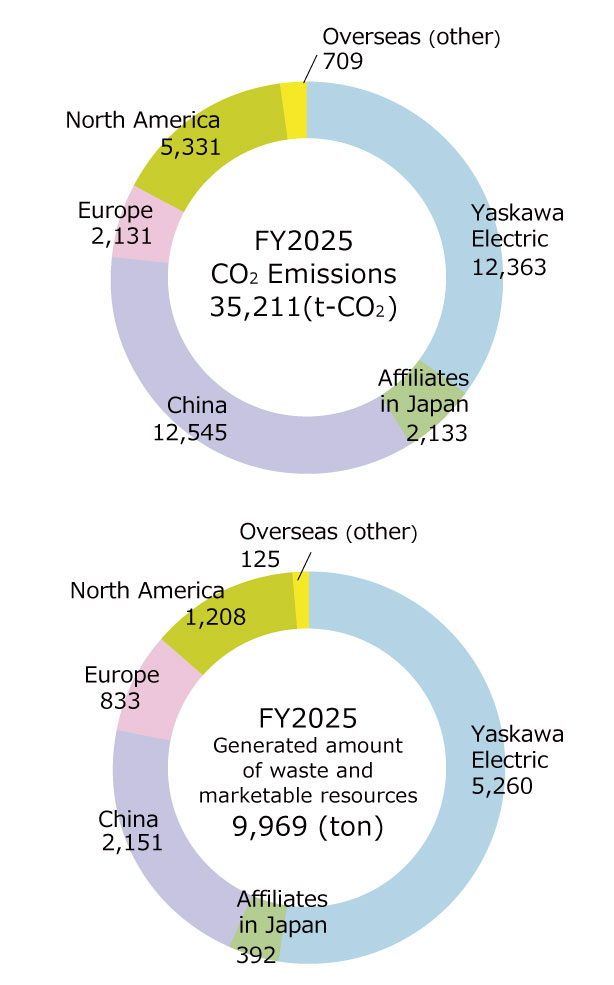
We also manage the amount of energy used, CO2 emissions, and amounts of waste materials and valuables generated from business activities of our domestic and international group companies. The scope of management targets group companies of high energy usage amount.
The graph at the right shows the energy-derived CO2 emissions of the Yaskawa Group in FY2025.
The Yahata-nishi Plant “Robot Village” in Kitakyushu has been implementing the “Clean Power 100 Project,” an initiative to reduce CO2 emissions from electricity to zero by FY2021.
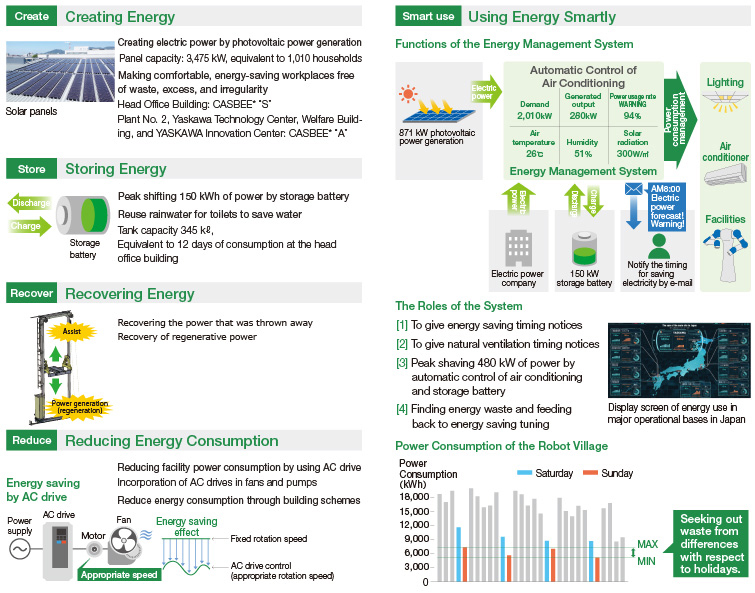
Robot Village focuses on five perspectives on energy: “create,” “store,” “recover,” “reduce,” and “smart use,” and also actively incorporates Yaskawa’s own environmentally friendly technologies.
At the Yaskawa Technology Center, which opened in the spring of 2021, in addition to the building’s superior environmental performance, we are also working to improve the efficiency of energy use by introducing environmentally friendly technologies, including the installation of more than 70 AC drives, matrix converters, IPM motors, and other Yaskawa environmentally friendly products, as well as solar power generation.
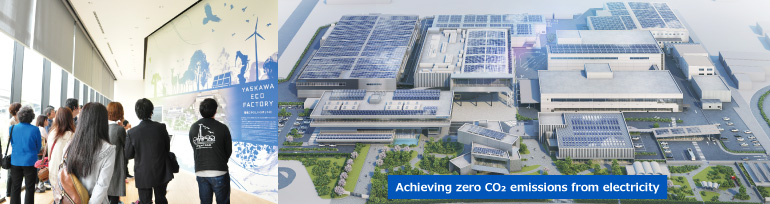
As a result of advancing the adoption of CO2-free electricity, we achieved zero CO2 emissions from electricity consumption at the Robot Village.
The environmental technologies used in the Robot Village are explained in an easy-to-understand manner to visitors of the Yaskawa Innovation Center.
*2 Robot Village is a registered trademark of YASKAWA Electric Corporation.
Robot Village was awarded the Energy Conservation Center Japan chairman’s prize in the 2015 Energy Conservation Grand Prize.
In the products and business model category, it also received the minister’s prize, Ministry of Economy, Trade and Industry, for Yaskawa Matrix Converter U1000.
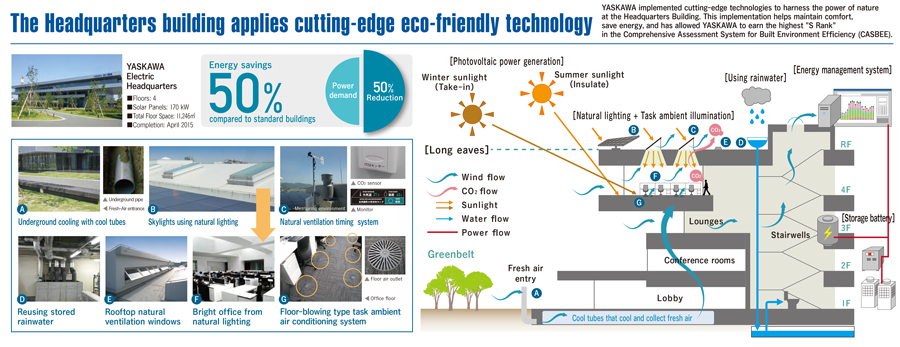
The head office building of Yaskawa Electric received the FY2017 Carbon Neutral Grand Prize*3.
Even after completion of the project, energy conservation operations have been thoroughly carried out and a 76% energy cut was implemented in comparison to standard buildings.
The head office also received the Kyushu Bureau of Economy, Trade and Industry’s Director General Award at the 2019 Excellent Energy Conservation Factory & Building Awards competition for its everyday energy-saving activities.
*3 An award system has been implemented annually by the Japanese Association of Building Mechanical and Electrical Engineers. It aims to contribute to building a “carbon-neutral” society in which CO2 emissions by buildings are reduced to nearly zero.
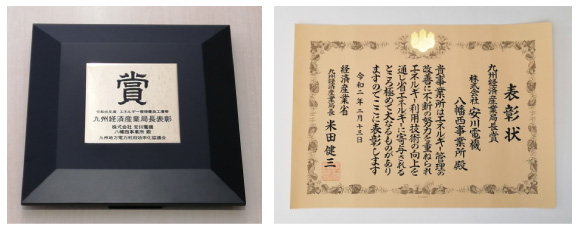
Certificate and plaque for Excellent Energy Conservation in Factory & Building
Yaskawa is a member of the Japan Climate Initiative (JCI), a network of companies, municipalities, and organizations working toward the realization of a decarbonized society in Japan. Established in 2018, JCI now comprises over 800 organizations and plays a leading role in climate action. JCI has made policy recommendations to the Japanese government, such as introducing carbon pricing aligned with international standards and adopting ambitious 2035 targets consistent with the 1.5°C goal.
Through our participation in JCI, we will further strengthen our efforts to reduce environmental impact and contribute to building a sustainable society.
Yaskawa is a member of the CMP Consortium. The consortium operates the Chemical & Circular Management Platform (CMP) and chemSHERPA, which serve as information-sharing systems connecting chemical substance and resource circulation data across the supply chain.
By promoting proper and efficient management and communication of chemical substance information and resource circulation data contained in products, the CMP Consortium aims to contribute to the realization of a sustainable society.
Through our involvement in the consortium, we fulfill our corporate social responsibility and strive for sustainable growth in harmony with the environment.


Copyright © 2003‐2026 YASKAWA ELECTRIC CORPORATION.